
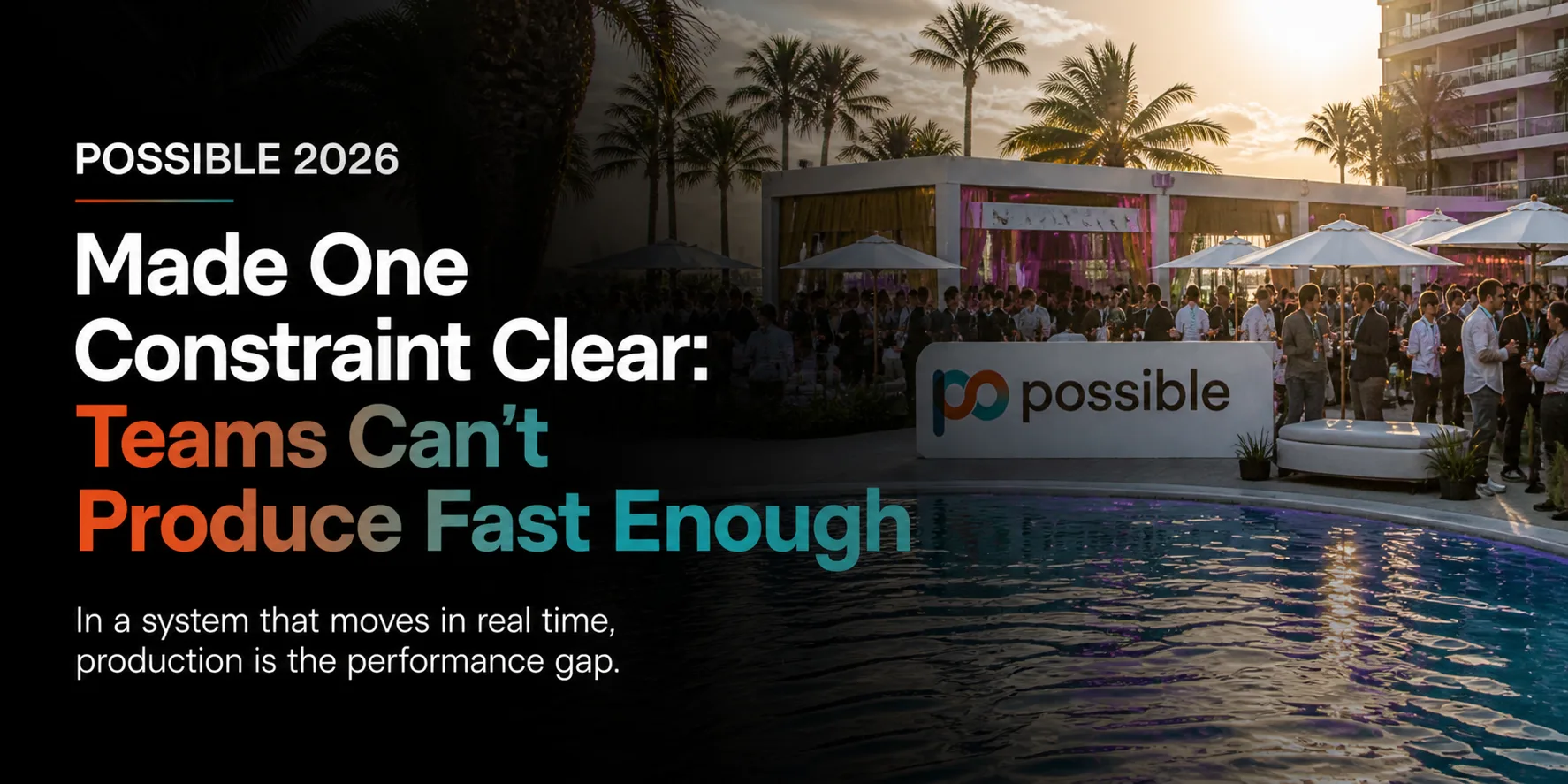
AI dominated the conversation at POSSIBLE 2026. That wasn’t surprising. What stood out was what happened once those conversations moved past the headline.
Very quickly, they stopped being about AI and started being about output.
Most of what gets discussed on stage still focuses on capability. What the models can do. What platforms are enabling. What’s coming next. But in actual conversations, the focus shifts almost immediately. Teams aren’t asking what AI can generate. They’re asking how much they can produce, how fast they can test it, and what it takes to operate at that pace.
That’s the real constraint. Production.
The System Is Moving Faster Than Teams Can Respond
One line that came up in coverage of POSSIBLE described AI as “removing the lag between question and answer.”
That framing came from AdExchanger, and it applies well beyond search.
Everything in the system is accelerating at the same time. Discovery is faster. Decisions are faster. Feedback loops are faster. The time between signal and response keeps shrinking.
What hasn’t caught up is production. That gap is already creating separation between teams that can respond and teams that cannot.
More Surfaces Didn’t Just Add Complexity. They Increased Demand.
The number of environments shaping commerce has expanded quickly. AI-driven discovery, creator content, retail media networks, and short-form platforms are all active at the same time, and each one behaves differently.
Each requires its own format. Each requires context. Each requires constant refresh. That doesn’t just make the system more complex. It increases the amount of output required to compete inside it.
Most teams are still producing as if that hasn’t changed.
This Is Where Fanomix Became Relevant
This is where the gap became tangible at POSSIBLE.
The Fanomix demo was straightforward. A product URL could be turned into usable creative in minutes. Variations could be generated, adjusted, and deployed without the typical production cycle.
The reaction wasn’t surprise that AI could generate creative. That part is already expected.
What changed was the direction of the conversation. Instead of asking what the system could do, people started asking what it could handle.
How many assets can this produce? How quickly can we test them? What does this look like across multiple channels?
Those questions didn’t come from curiosity. They came from pressure. Because most teams are trying to operate in environments that now require far more output than they can produce.
Fanomix didn’t introduce that problem. It made it visible.
Production Is Now a Performance Variable
Another line that showed up across POSSIBLE recaps was that “the era of ‘set and forget’ marketing is over.”
That observation appeared in multiple summaries, including Doceree.
Performance is no longer driven by targeting alone or channel selection alone. It’s driven by iteration. How many ideas you can put into market, how quickly you can test them, and how fast you can learn what actually works.
Production capacity directly affects all three.
The Gap Is Already Forming
The difference between teams is starting to show. Some teams are still producing a limited number of assets per cycle. Others are testing continuously, generating variations at scale, and feeding that output back into faster learning loops.
That gap compounds quickly. More output leads to more data. More data leads to faster learning. Faster learning leads to better performance.
Most teams are not operating inside that loop yet.
The Net Effect
Creative production is no longer a support function. It is directly tied to performance.
The constraint is output. Teams that can produce, test, and iterate at higher volume will outperform teams that cannot. That gap is already forming, and it will not close on its own.